Why forecasting matters to startups… and how to do it

“How can something seemingly so permanent come about so quickly?”… my first thoughts as I drove through the Oregon high desert looking at perfectly conical dormant volcanos:

 Volcano

Volcanos like this take 10,000-50,000 years to form – a millisecond in geological time – yet dominate the landscape and ecosystem around them.

The most successful tech companies are just like volcanos. Most investors would agree that a number of the largest market cap companies to be in 15 years are tech companies yet to be discovered. Fifteen years ago, this was true of Google, Facebook, LinkedIn, Twitter and Apple 2.0. Think about how much these companies have changed us in this short time.

Human beings are bad forecasters because the gravity of our minds collapses time to a point

As a VC, the volcano analogy is powerful to me. If you were a shaman who predicted the Mount Mazama explosion 7,000 years ago that created Crater Lake, you’d be pretty esteemed and have many goats. I am looking for shamans (disruptive entrepreneurs) and future volcanos (the next Google). Easy said, much harder to actually forecast.

Human beings have a terrific handle on space but not time. We have biased and filtered views of the past and very fuzzy views of the future. We heavily value the now and recent past and heavily discount the far past and most of the future. In other words, our minds have a powerful gravity that collapses time to a point:

Point

Evolutionarily, this makes sense. When life expectancy for cavemen was 30 years, the far future didn’t matter at all, and meeting basic food and water needs now heavily overshadowed a few weeks out. The past was also hard to objectively weight in decision making when there was no writing, recording or video – only as good as our memory. So, we are not wired to be visionaries, disruptive entrepreneurs or VCs.

Forecasting is containing our biases and preparing for multiple paths from A to B – understanding risks and how to live with them

I started thinking about time and forecasting while reading Nate Silver’s Signal in the Noise, and borrow some concepts from Silver here. Foremost is the difference between prediction and forecast. A prediction is a belief – a point outcome that you induce from myriad data points and biases in your head. Predictions also tend not to have a “how” associated with them – how will it happen? For example, a crowdfunding startup I meet with says it will have 10% of the market in five years. They simply believe it or “hand wave” it.

A forecast is very different. A forecast may involve a point outcome with a “confidence” range about it or set of possible outcomes with probabilities attached. A forecast is deduced from a buildup of data and assumptions. It is path dependent, and the path is described. As importantly, attempt is made to minimize bias. An example here would be a local delivery business (let’s call it LicketySplit – Uber for local delivery) that proved the model in one city, has operational metrics from that city and applies them to a three year scaling model for a 20 city rollout. They also include an upside, nominal and downside case. Sensitivities to assumptions are known. Note that I would differentiate forecasting from budgeting. Forecasting leads to a budget; it is the “why” and “how” behind a budget.

Also important is the difference between uncertainty and risk. Uncertainty is the unknown: “When we launch this product, we don’t know whether consumers will like it.” Risks are possible outcomes with probabilities and business impacts understood. An example narrative on risk is: “We did consumer research before launch, benchmarked against other product launches and think there is a 70% chance that women aged 30-40 will buy the product in high volumes – enough to build a very successful business. We also think there is a 35% chance that middle aged men will also like the product, presenting a lot of upside. However, there is a ~30% chance that no one likes the product and we are unsuccessful. We have put a strong marketing plan in place to optimize these probabilities.”

Here is a visual way to think about this “risk based forecasting”:

 2x2

There is as much value in the forecasting process as in the result

Many people resist this type of forecasting: “The only thing we know about the model is that it will be wrong… too many assumptions and guesses”. That is always true of a point prediction but often untrue of a forecast with outcome probabilities, where the actual will fall somewhere in the range. Regardless of where it falls, you are prepared. The first and last investment I made in a company with a team that resisted forecasting became a partial write-down in 9 months. The team was not mentally or operationally prepared for the downside state that materialized and kept burning cash without revenue materializing.

The process of forecasting is also helpful for understanding the sensitivity of your startup to factors you may not perfectly control. In a startup growth forecast, two key examples of this are sales cycle time and days payable. For some startups, increasing either by 25% can increase monthly burn by 50%. This is a “hypersensitivity”. Understanding hypersensitivities allows a defensive posture in the downstate while maintaining the ability to lean into the upside. Of course every startup is hypersensitive to revenue!

As startups (and their markets) mature, they become easier to forecast because there is more data on internal and market metrics. But even early stage startups can be forecasted. There are several very early stage companies in the HPVP portfolio that hit or exceed their aggressive forecasts every month. Maybe this is because forecasts can be self-fulfilling too… another value in forecasting.

Risk based forecasting in five steps (Using LicketySplit)

1. Define the biggest risks (or opportunities) to your startup

There are lots of little risks in a business like LicketySplit: sales cycle risks, customer satisfaction/renewal risk, etc. But all of these are easily adjustable assumptions in a model that we can test and understand later. In this step, I’m talking about identifying really BIG risks – often binary challenges over which you have very little control. For LicketSplit, it might be that Uber itself enters the market with the same offering. It is very hard to know the probability of this happening, so the point is to define a possible outcome (and business approach to it) such that we can survive if it happens. With reading and snooping, you can probably estimate with some accuracy whether the probability is high (>50%) or low (<25%). If >50%, you might decide to shut down the business right now! Here we’ll assume the probability is low around 25%.

On the flip side, LicketySplit is working on a really BIG opportunity to provide delivery service to the largest regional dry cleaning chain. The CEO handicaps it at 50%. So there are four “states of the world”, each with a rough probability as shown below. This is a form of scenario planning with scenarios numbered from 1 (best) to 4 (worst).

Scenario

(Note: In addition to forecasting for an existing startup, this type of scenario planning is helpful for identifying the next big thing in a market or industry where a current or future gap exists and a new startup is needed!)

 2. Define the key metrics (assumptions) in the startup

What are the key metrics of your startup? Here are some example metrics for LicketySplit, which sells their service via B2B sales reps to SMBs and then monetizes per delivery that its SMB customers use.

  • B2B Sales: SMBs/sales/month, sales cycle, rep ramp efficiency, etc
  • Revenue: Order/SMB/month, price per order, etc
  • Gross margin: Cost per order, capacity utilization, etc
  • Cash management: Days receivable, billing frequency, etc

3. Build a model

Build a simple excel model that reflects how your business works and grows over the next 12-18 months. The model is built on your key metrics. There are two ways to model a startup.

  • Top down: In a top down model you say, “the market is $X big; we start from zero and by year 3 capture Y% of it.” That defines revenue (or users for B2C) which then drives cost associated with it – tech spend to deliver the product and sales spend for direct sales (B2B) or CAC (B2C). For startups, I don’t like top down models. A lot of startups’ markets are opaquely defined, and in most cases success comes from good general execution not by competing with others for market share. Top down models always feel more like predictions than forecasts to me.
  • Bottom up: Instead of top line being the driver of the rest of the model, the costs to acquire top line (sales people in B2B or CAC spend in B2C) drive top line growth based on all the assumptions outlined above. Other costs (tech, G&A, etc) flow from the top line and product development needs. If you find that the revenue line is not growing fast enough, hire more sales people or spend more on CAC… if you can afford it. 

4. Find evidence or benchmarks to support metric assumptions and ranges

For each metric (assumption), find data in your business or others’ to define a reasonable range of how the metric will actually perform in your startup. For LicketySplit, let’s say we have evidence from their first market that the B2B sales cycle is 45 days. Based on this, we’ll consider a range of 30 to 60 days in other cities for the No-Uber scenarios but 45 to 90 days for Yes-Uber scenarios given Uber will have lots of competing sales people out there mixing the message.

The more established your startup or industry is, the more you know your metrics and the narrower your ranges can be. If you have no data yet on a metric, look for outside benchmarks in similar companies/startups, online blogs or comprehensive industry resources like the Pacific Crest SaaS Survey.

5. Apply the model to your scenarios and check sensitivity:

For LicketySplit, the model will greatly aid planning for Scenarios 1, 2 and 3. In the No-Uber scenarios, modeling ranges of delivery cost structure, payment terms and various B2B sales efficiency metrics will show the range of funding necessary to support the business… and which metrics cash is “hypersensitive” to so you can watch them closely.

For scenario 3, sales efficiency will be the big issue with more competition in the market. Here you will test forecast performance with a 45-90 day sales cycle range instead of the 30-60 in the No-Uber cases.  The impact of halving sales efficiency will not be pretty, but fortunately LicketySplit will have a big customer already on board to help support the company.

The model is not very useful in planning for Scenario 4 (Yes-Uber, No-Big Customer). In this case, sales metrics will be tough, and there is no major customer to rely on. Here I might ignore the model and simply ask, “how long can we survive on the current fundraise without revenue while we pivot?”

This type of forecasting helps you ASK GOOD QUESTIONS and starts you on the path of answering them. How long can we survive if things beyond our control really suck? How much sooner do I need to raise capital if my sales people are half as efficient? How much dilution can I avoid (by raising less equity) if I have slightly better payment terms from my customers? Again, the process matters as much as the result.

Added 7/23/14: For another helpful view on startup forecasting, see Hunter Walk’s recent post HERE
Chicago startup funding approaching 2000 levels: Will this time be different?

Here are a few slides on venture dollars raised and deals done in Chicago since 2007 and how this compares to 2000.

Mostly, this is terrific news. Chicago is attracting a much larger share of US venture capital than it used to:  roughly 3.5% in 2013 versus ~1% percent in most of the prior decade.

There are good reasons to believe this run will be different than 2000 (for Chicago and the whole US), but on the chance of another bust, startups need to plan ahead.

A VC’s view on IoT: Everything is changing… still

The Internet of Things (IoT) is a fundamental shift in our world – but it is not the first shift we’ve seen of this magnitude. IoT is our fourth industrial revolution. As with all others, it will create winners and losers. One loser may be the hardware model, as software models emerge powerful and sticky – with commoditizing hardware only serving to stretch the reach of software. Under this threat, many hardware companies are seeking software models, and some hardware giants are investing in software startups to get ahead of the wave.

There will also be unintended human consequences of the IoT paradigm shift. It will both solve problems and create new ones… an entrepreneur’s dream. Below is one view on the IoT – what it means to entrepreneurs, investors and all of us as humans.

I am lucky to be on this ride with our portco, TempoIQ, which started my thinking on this.

Venture capitalist to venture capitalist: we can do better

There is a constant tension in the startup sphere, tech press and sometimes board room between entrepreneurs and VCs. This isn’t surprising considering the fierce confidence and independence required to operate successfully in either role – and given that cash and stock are being exchanged.

Who bears responsibility for the tension? It falls to both sides, but as professional service providers who are permanently in the market, we VCs need to do better. This was highlighted last week in Ryan Caldbeck’s VentureBeat article “Entrepreneurs to venture capitalists: We’re looking for 5 traits.” I could sum up the article in four words: be honest and respectful… or… don’t be an ass hole.

Calbeck’s article was timely for me. I want to really understand what entrepreneurs think of VCs and what VCs think of themselves to be a better VC myself. Time to rev up the survey engine. One survey went to VCs – 58 (mostly partners) answered. Another went to entrepreneurs – 162 (mostly CEO/founders) answered. Not perfectly scientific but directional. VCs, hold onto your seats…

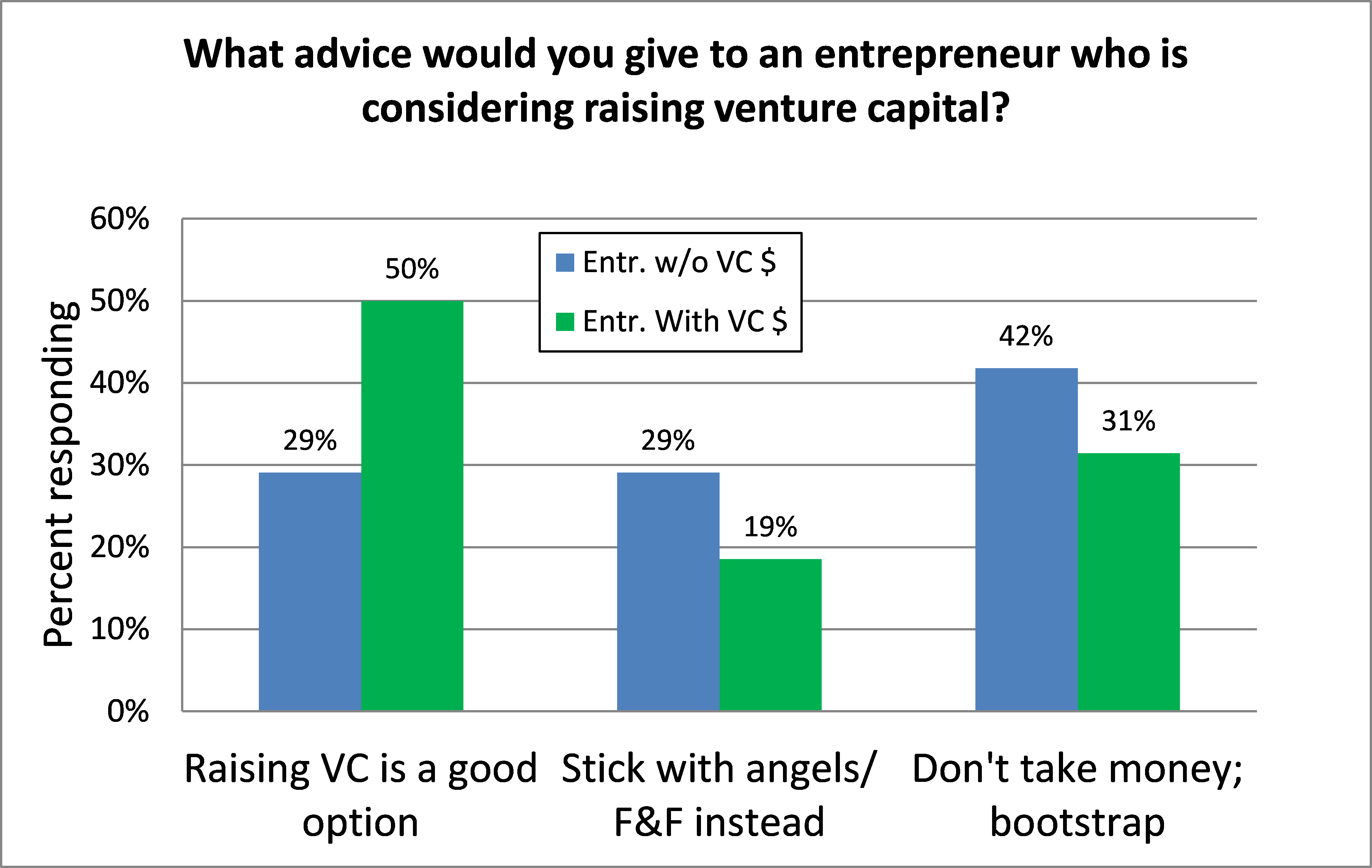
Only 50% of entrepreneurs who took venture capital see it as a good option for others:

It is true that ~75% of venture backed startups fail… so maybe this result is just sour grapes. But I hope that I walk out of my losing VC bets with founder recommendations despite the shared failure. The data below look even worse when filtered for entrepreneurs who haven’t taken venture: fewer than 1/3 of non-venture backed entrepreneurs would recommend venture capital to another entrepreneur. 40% would instead recommend bootstrapping. This is bad for VCs. Some of the deals I most want to be in are the ones who don’t want outside capital. I hope I can convince them.

Final4

Hate congress, love your congressperson: 60% of entrepreneurs would recommend most of their VCs, but most entrepreneurs wouldn’t recommend the other VCs they’ve met with

The congress analogy is promising for VCs individually, but even here, we have an inflated self-view of what entrepreneurs think of us:

 Redo3

The above shows that about 90% of VCs would say most entrepreneurs they work with would recommend them, but only 60% of entrepreneurs would likely do it. Why? See below.

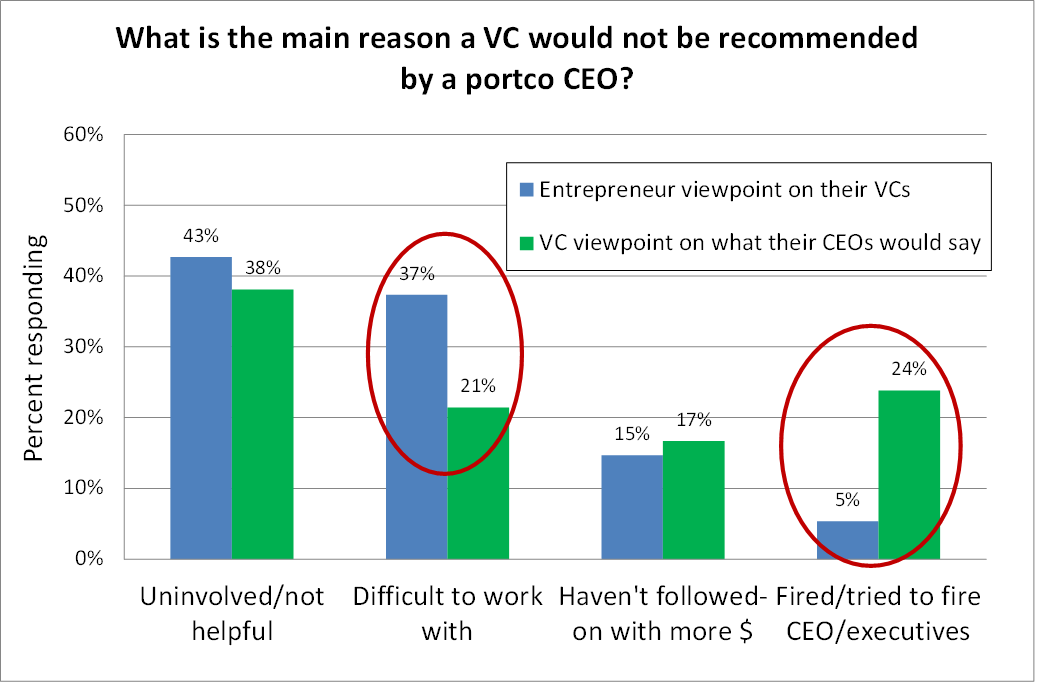
Redo4

While both VCs and entrepreneurs agree it’s because VCs are often viewed as not helpful or not involved, VCs believe a lot of hard feelings tie back to executive firings. Entrepreneurs aren’t actually so caught up with that, but they do think VCs are difficult to work with (ass holes?) at about twice the rate we think we are.

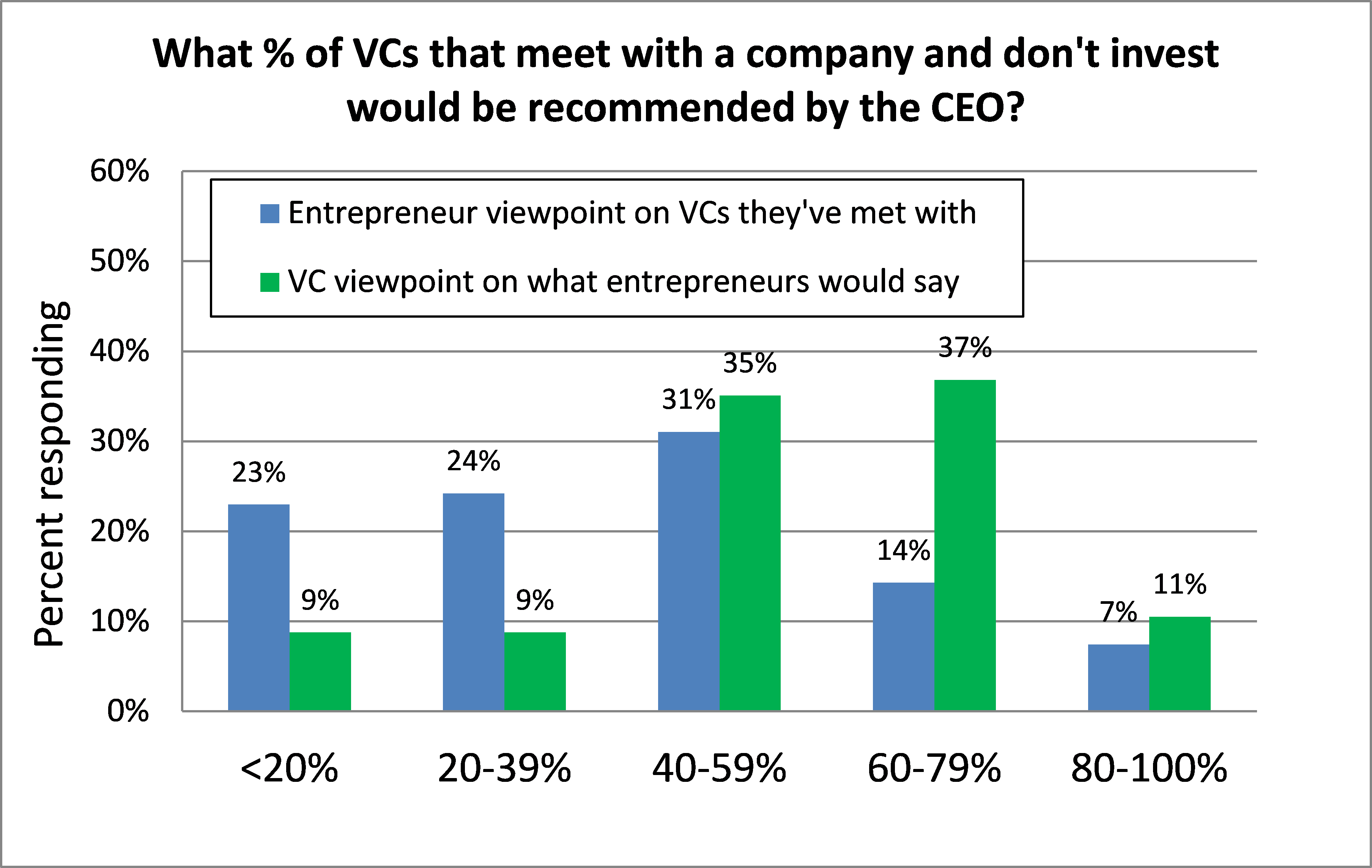
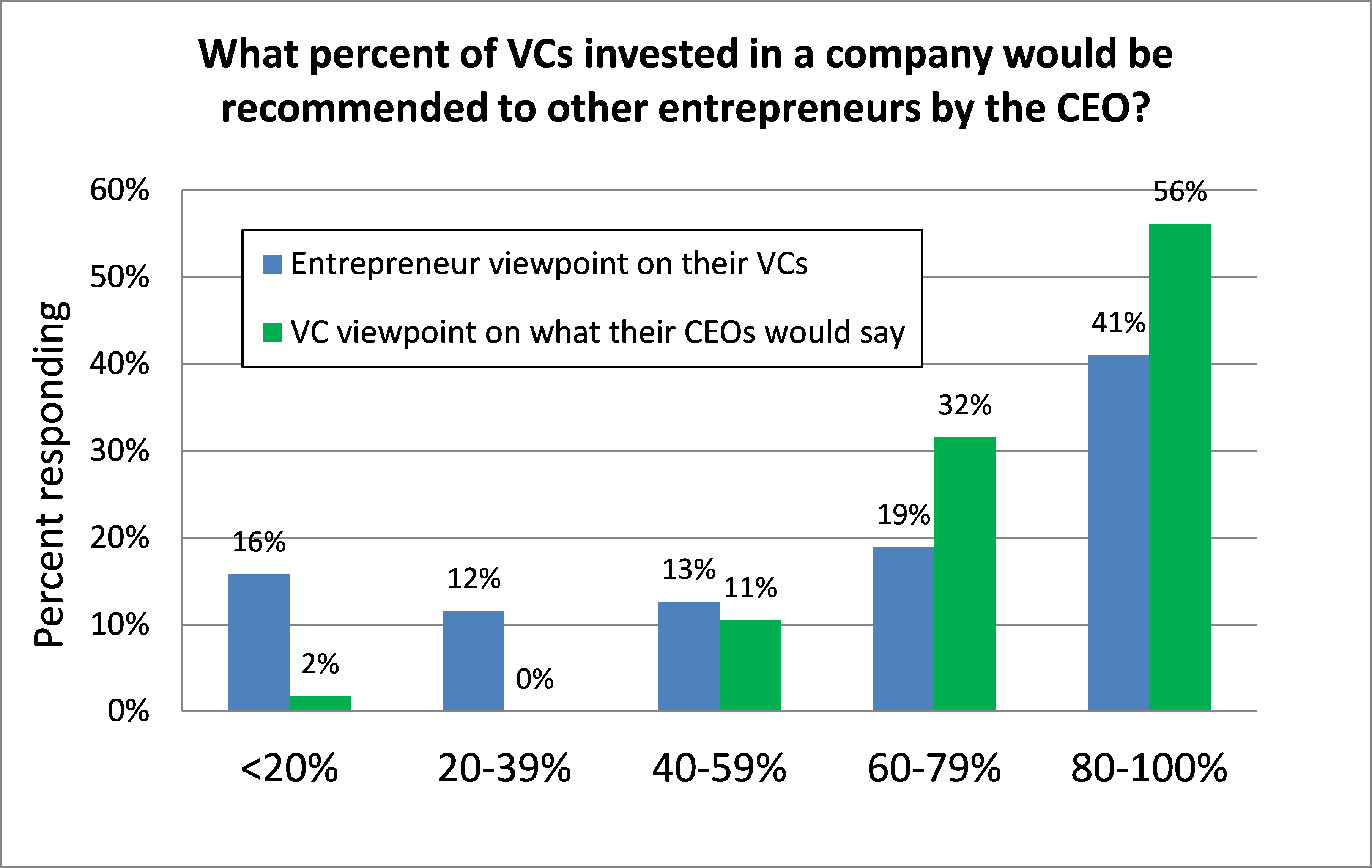
This VC self-awareness issue gets much worse when VCs consider what the CEOs they don’t back would say about them:

Redo1

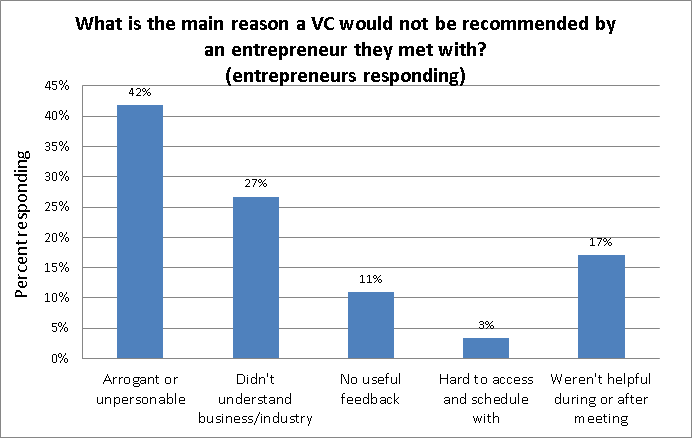
About 80% of entrepreneurs would recommend less than half of the VCs they meet, while 85% of VCs think most would recommend them. Here’s why according to entrepreneurs:

VCVC5

Overwhelmingly we come across as arrogant, don’t seem to understand the business or are unhelpful. Yikes. … back to Caldbeck.

This self-awareness disconnect is an unfortunate outcome of how the startup/venture market works. Entrepreneurs rarely give feedback to VCs (though we VCs certainly dish it out). No matter how much an entrepreneur dislikes you, they’re going to ride it out on the chance of getting money from you. Cash is king. There is nothing to gain and lots of risk from giving feedback to a VC – being branded a “hot head” or “difficult founder” in a close knit market. Here’s another way to think about it: VCs are constantly grin f*&%’d, so we think pretty highly of ourselves. To be fair, entrepreneurs are GF’d too but at least for them it can be avoided. VCs can just say “no” faster. Another point of Caldbeck’s.

VCs need to actively solicit feedback to stay in touch with their entrepreneur customers and the market. My colleague Taylor Davidson at KBSP.vc does this with a semi-monthly anonymous survey. Nice.

Entrepreneurs’ dissatisfaction comes from misguided expectations set by VCs

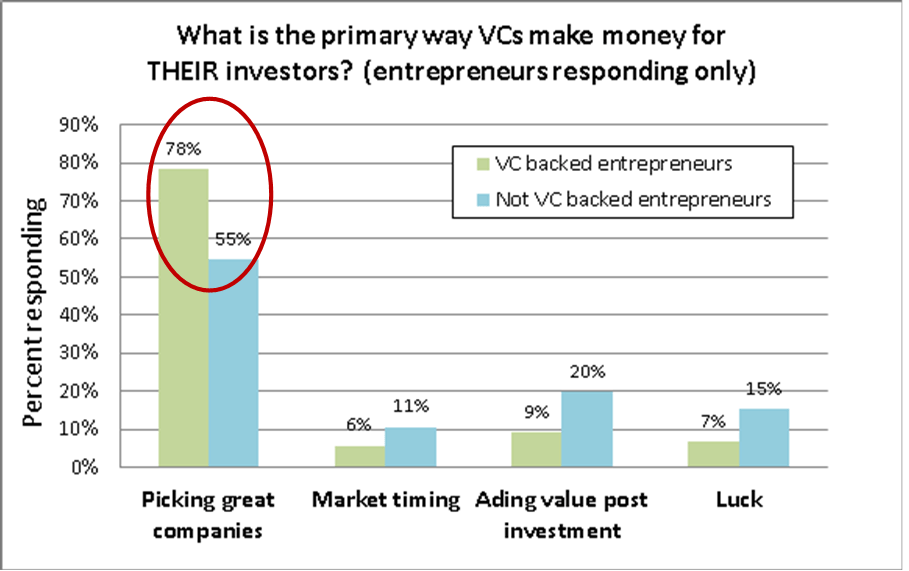
When I meet with entrepreneurs, I tell them most VCs overpromise and under-deliver, and I am no different. We all have our moments of adding value – sometimes significant, but when you do the math, how much time does a VC really put into each portco? What really matters is whether a VC and entrepreneur can get along and respect each other when things get tough. Entrepreneurs need to know that we VCs make our money by picking great teams and companies and letting them run – adding value is secondary. VCs overwhelmingly agree with this. On average entrepreneurs seem to understand it too…

 VCVC6

…but when you split it out between venture backed and non-venture backed entrepreneurs, you see where the disappointment comes in.

Tester

Only 55% of non-venture backed entrepreneurs (eg, the ones looking for money) versus 80% of venture backed entrepreneurs really understand that VCs make money primarily from picking. Making money by picking is not bad. We just need to be honest about what we do and don’t do, know and don’t know so that entrepreneurs aren’t disappointed after investment.

The role VCs play is not as “trusted” as we’d hope

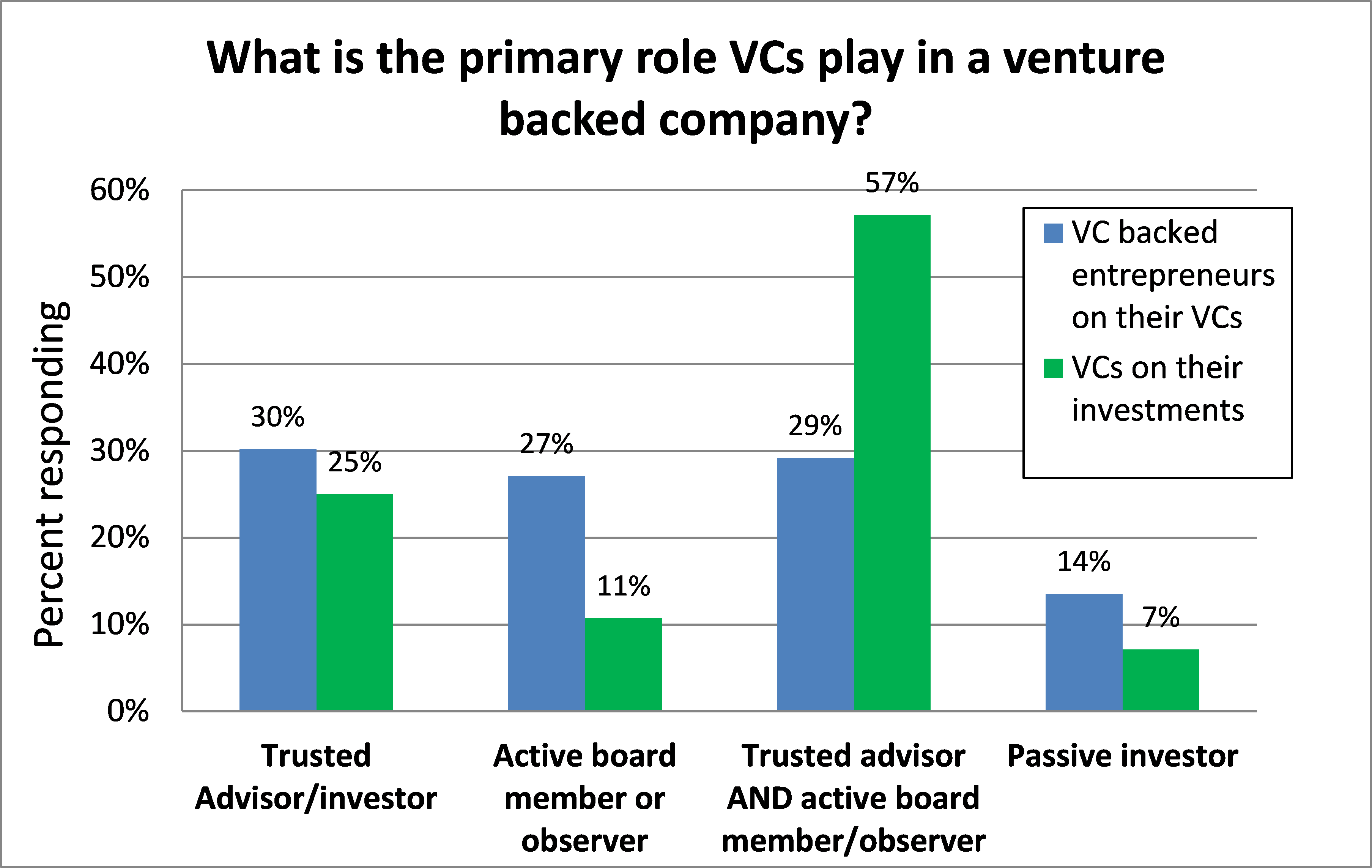
VCs think they are “trusted advisors” in addition to active Board participants at twice the rate venture backed entrepreneurs say so – another VC self-awareness issue.

Tester2

Why are VCs not as trusted as we think we are? Our interests are usually aligned with the entrepreneurs, but there are times when they aren’t. Our behavior during these times can really turn entrepreneurs off. We need to communicate about what is happening – that we are balancing our obligation to the company and to our partnership, or sometimes forcing hard board decisions on people for overall company results. As one of my portco CEOs said when he was diligencing me: “Every VC flies off the handle at one point or another. So far, I haven’t heard of you doing that, but I expect you will.” I have, in fact, and I am sorry. Not surprisingly, it was a situation where I was caught between a company and my fund. I am lucky that my CEO called me on it, and we worked through it. Most don’t. Bottom line, it’s hard to be trusted when people don’t understand what or why you’re doing something. VCs, communicate.

The good news: we do sometimes add value

While a few venture backed CEOs held out that their VCs don’t add value in any way, most saw some value.

Tester1

VCs have an inflated view of their 1:1 coaching of CEOs (not surprising) but also underestimate their value in board meetings. This may tie to the ruckus about startup board meetings being useless. VCs and some CEOs may tire of their endless board meetings, but to many entrepreneurs these meetings are important and likely the time when they get the most face-to-face interaction with VCs (like it or not).

VCs, if you are thinking of all the reasons why this is BS, you missed the point

Maybe you are the exception, and certainly some of us are better than others. (Some of us are better at certain times of the day!… we are only human.) But take the feedback, and let’s get better together.

Your SaaS startup website is your showroom – is it awesome, or is it a FAIL?

You have content, e-mail and social marketed, optimized SEO and spent on PR and SEM to drive customers to your website… but the customer shows up and doesn’t know who you are, what you’re selling or how to ask questions. FAIL. All that traffic effort and spend is for naught. We’ve all had this experience in a real store. Walking in, being ignored, or worse not being able to find someone to help. You leave.

Despite endless sharing of best practices on website structure and design in the market, there is still a wide range of quality in the websites of even the most innovative startups. A great myth of SaaS and e-commerce business models is that they are self-service – a battle won on the product front. Customers will narrow down options, compare with your competitors and choose yours because it is the best product, right? Nope. This thinking is an unfortunate fault of the product obsessed tech community. As I’ve said before, Service is a big part of SaaS, and service starts with your website “showroom” experience. It’s time to change our thinking:

Your website is a place for you take to action, not your customer – your chance to touch, wow and speak with your customer

Below are a few tactics to reinvigorate the showroom conversation with your customer – and also highlights on urgent trends changing the way we design customer interaction. Most of these concepts apply to product design as well, but here our focus is “showroom” design.

Chat: literally, talk to your customer (aka, move beyond the contact form)

As the digital world moves habit from phone to email to texting, a phone number on a website is an inadequate help lifeline for your showroom visitor when your goal is conversion. Lower the barrier with live chat. According to Forrester, 44% of online consumers report chat as critical during-purchase website feature. While this is a B2C based metric, I’m a firm believer in the consumerization of B2B software purchasing behavior. Professionals are consumers too. They want attention.

There are affordable SaaS chat solutions abound including LiveChat, ClickDesk, Hipchat, etc. They have slightly different features and backend integrations. If you use marketing automation (and you should), be sure to look for integration with Marketo, Hubspot, etc. Older ones are popups that take time to load. Newer ones work in-browser. There are some new services using video chat like, WorkFace. These are worth exploring too, especially for large ticket price sales where trust and relationship are important.

As in a real store, don’t wait for customers to approach a sales person with a question. When a customer lands, automatically initiate a chat: “Hi, I’m Guy. How can I help?”. Most customers will ignore it but be happy to know you’re there; the ones who engage will be wow’d. This sure beats the nauseating contact or e-mail form where customers fear for the abyss of non-response.

The cost of chat is needing warm bodies to staff it. For most products and services, this can be done with a few bright-eyed marketing interns or even an existing customer service or inbound lead staff. Of course, this type of service is easier to justify when a lead could be worth thousands of dollars (as in high priced B2B SaaS), but I know freemium/premium models that make it work too.

Call your customer to action: What do you want your customer to do in your showroom?

A shocking number of startups websites are missing calls-to-action. A big fat “push me” button above the fold in the middle or slightly offset. When a customer lands, they know exactly what they should do. Push the button. Here are some classic call-to-action concepts:

  • High ticket price B2B SaaS: “Get a demo” or “Chat with us”
  • Low ticket price B2B SaaS: “Start your free trial”
  • B2C SaaS: “Login” or “Signup for free”
  • B2C app: “Download now”

But don’t stop at a call-to-action; consider personalizing it based on traffic source our other visitor attributes (geography, time of day, etc). Hubspot has a terrific post covering a 42% conversion lift seen from personalizing calls to action.

Some businesses like salesforce.com roll with multiple calls-to-action (also notice live chat tab on their website). This can work, but A/B test the crap out of it.

Below is a screenshot of our portfolio company, Farmlog’s, landing page (arrows are mine). They do the above really well: Calls-to-action (one for information, one for signup), immediate ability to signup on front page and tab for help. The help tab is a chat tab when staffed and a contact tab when not. Either way, you don’t have to search for help. The site is a bit busier than you get with a very well known product like dropbox (check it out, super simple). This is because unlike dropbox, FarmLogs has to explain what it is.

Click

Consider social login: start the conversation fast and knowing as much as you can!

Below is a graphic of my personal cloud database. Most of this data is public and even more of it I’m willing to share if it makes my life easier. Use this stuff!

In the cloud

Mintel reports that while only 10% of baby boomers are willing to share social profiles, that rate is three times higher among Millenials. It will keep increasing. Offer Facebook, Google, LinkedIn and/or Twitter social login as an option for your SaaS trial enrollment. It will increase conversions for people who don’t want to enter the same old info into boring forms. It will also let you market to them better during their trial given the data fields you’ll get access to (age, geog, profession, etc). Which logins to offer? Here’s a way to think about it:

  • High ticket price B2B SaaS: LinkedIn
  • Low ticket price B2B SaaS: LinkedIn, Google (note that a lot of SBs and MBs use Google Apps)
  • B2C SaaS: Facebook, Twitter
  • B2C app: Facebook, Twitter

AngelList uses social login really well. Simple, one click signup. It also fits their business model perfectly.

Angel

There are, of course, downsides to putting someone else’s brand on your site, entrusting security to them and using customers’ own data. A 2012 MailChimp blog post on social logins has some great counterpoints as you consider using social logins.

Video: show it in pictures AND words

Kissmetrics reports that website visitors who watch videos are ~75% more likely to convert than those who don’t – OK, some possible selection bias here, but Treeopedia found a 27%to 46% increase in a controlled study. Wow.

There was a time a year or so ago when every startup had a 60 second cartoon video of what it does. Way overdone. But video can be a powerful tool to educate potential customers on specific products, services and use cases. For example, video is great way to profile customer success stories. Keep them short (in most cases 30-120 seconds) and directly embedded. ReelSEO reports a 2x view rate when videos are embedded directly rather than as a button with link. Here is much more from VisualWebsiteOptmizer.com on how to use video on your site to increase conversion.

In many cases, video is best used “below the fold” so it doesn’t distract from the primary call-to-action for those who are really motivated when they land. Our portfolio company LevelEleven is one that uses video very effectively below the fold to educate visitors who want to know more before they signup for a demo. See screenshot below. Notice the use of an accompanying secondary call-to-action to “learn more” right next to the video. And the video is embedded with a single click to play. A lot of video embeds involve a popup with 2-3 clicks to play. Complicated.

LE

Responsive design: RD is a technology solution, not a design solution.

With Americans spending 1.4 hrs a day surfing the web on a mobile device, responsive design is becoming table stakes to ensure customers can engage with your showroom (or product) from any device. This is true whether you sell product or software to consumers or businesses. But it is a means to an end, not a design nirvana itself.

Matias Duarte, Android’s design chief, says that responsive design is a technical answer not a design phenom. “Responsive technology is design for a device not a user” he says. The nuance is important. Responsive design meets users’ basic needs across multiple screen sizes through mechanical resizing and configuration of site features and elements. But the resulting experience on each device may not be design optimal – either for user experience or business goals like conversion, transaction, and engagement. Optimization of calls-to-action, video content, image content, flow, etc on a 21” screen with keyboard doesn’t mean those features are optimized on a 8” or 4” touch screen.  User behaviors and context (see below) are different with touch and smaller screen sizes.

Duarte further dissects this saying user design is no longer about enabling interaction on multiple screens (what responsive design does) but enabling “natural user flow BETWEEN screens”. People don’t just use one screen or another, they use multiple throughout the day or even at the same time.

Below is the full video of Duarte’s interview with The Verge on this and other topics. Long but priceless.

Context: the new holy grail of user design

15 years ago, your showroom visitor was likely a professional employee, under 40 or otherwise relatively well-off internet user… sitting at a desk with a screen, keyboard and mouse. You could make a lot of assumptions with pretty limited information.

Not so today with screens everywhere, every kind of person using them at every time of day. CONTEXT has now become the critical paradigm to understand users’ engagement with your showroom. You need to understand who is doing what, where and why when engaging with your site; there are a diverse set of users and situations you are designing for. That’s the bad news.

Cennydd Bowles, Design Lead at Twitter, wrote an amazing blog post last year on the use of context in user design. I’d consider Twitter to be a leader in user design – including facilitating flow across endpoints. Cennydd designs for seven types of user contexts: Device, Environment, Time, Activity, Individual, Location and Social (yup, DETAILS).  Read the linked post for much more info on this.

The good news: While today’s connected world is more complicated than it was two decades ago, there is a lot more data available to help you understand context. That is part of the case for social logins – deep public and semi-public records of customers’ needs, wants and desires right at your fingertips. We also now have layers of cookies, countless mobile sensors on our phones and the “big data” ability to crunch these inputs in real time. But Bowles warns the availability of data can be a trap for mistakes and distrust: (1) Assumptions based on data are correct on average, but not in each customer case, and (2) the existence of public data about a person doesn’t justify its unpermitted use. We must “assume gently” and tread lightly.

Actually doing it: design as iterative proposition and testing of hypotheses on user experience

Okay, so you need to move away from mechanical responsive design and optimize for flow between screens used in many different context. Easy, right?

As the header indicates, great design starts with informed hypothesis development. You can derive hypotheses from design best practices (there are myriad best practices on calls-to-action for example), user focus groups, live site user data, etc… This process has been followed for years, but Duarte’s idea of optimizing across endpoints is fairly new. To do this, you needed the ability to track user activity across screens. Easy for “logged-in” applications. Harder for non logged-in applications.

Then you test, measure, re-hypothesize, test, measure… optimizing. KissMetrics has a case study on a customer’s website optimization journey starting with workflow mapping and moving to A/B testing – a great primer if you’re new to this. You can run A/B testing to your hearts content yourself or use a testing automation tool like Optimizely. Remember, however, that mechanical A/B testing isn’t a substitute for design thinking and process. It is just one of many tools, only finding local maximums based on the options you define from informed hypothesis and iteration.

Nothing works without ownership: someone has to own the showroom at your startup

I’ve seen showrooms fall by the wayside in small startups strapped for resources. This is a big mistake when getting customers is the most important – and hardest – thing to do. Early on, “the website” usually falls part time to one or two people on the engineering team who make ad hoc tweaks based on opinion and conjecture from the exec team. FAIL. The showroom is its own product and needs to be treated as such. In our portfolio companies who do it the best, showroom design and optimization falls under the purview of the marketing team or “growth hacker” function with close sales team cooperation.

Would love to hear from others on this topic!