The battle for the home – and my own NEST hacking skirmish

Front

For decades, the consumer’s home was monetized by hardware (TV, computers) and content subscription (cable) business models. Much less so software or data. This is about to end. The home is being “eaten” by software (and data) as is the rest of the world. It is the next major battleground for tech’s giants, and the reason behind Google’s Nest Acquisition. The battle cries started in your smartphone but are soon to resonate in your HVAC, entertainment, appliance, security and other systems.

This is a story in vignettes about my inviting the battle into my home – my journey installing nest (and nearly failing) in a four-pipe 120V fan coil system* and what I learned about the changing world and myself.

*You tech readers will pardon my geekiness. Hoping some of the home hackers (ugh, such a YC word) will find use in the technical stuff in here. You home hackers will pardon my ruminations on the tech world.

Make: To watch is to exist, to build is to live

I’ve had a nagging need to build and make things since I was a kid. Hours in my dad’s shop led to furniture building school after high school and an early career as an engineer. Being a VC scratches all my itches of curiosity, short attention span, excitement and working with amazing people… but I don’t build anything. I serve others in their own journey to build, which I love, but my hands still feel empty. So I cherish the opportunity to pull wires out of my apartment’s walls and see what I can do. 

Guts and entrepreneurship: Sounds like you need to buy some relays

Over lunch with @harper Reed and @dylanr Richards, we chatted on the growing home automation trend, consumer’s willingness (or not) to pay for home software models and our respective forays into the trend. We all seemed to have Sonos, some chosen standard, (Zigbee, Z-wave) and some version of a home automation hub (Vera, Revolv, SmartThings etc) but I was the laggard on nest. Nest was designed for 24V controlled systems, not for the 120-240V systems often found in commercial and high rise building… like mine. I’d been doing some research. My system was not supported by nest and would require multiple relays, a transformer and altering a high voltage system – aka, a big hack. Harper’s response: “Sounds like you should get some relays”. This is why I love entrepreneurs. The best ones just go do it.

Collective knowledge: The more info we have, the more confused we are

Time to learn! To the internets! 15 years ago, I would have spent weeks calling suppliers, visiting electrical suppliers and eventually hiring an electrician. Now, with three hours of googling on my couch in my boxers, I was inductively assembling the vast collective knowledge of others who came before me. But it was damn confusing. There were hints about how to hack a 240V or 120V system for nest – good discussions and overviews here and here – but nothing complete.

Whoever can solve this problem of tying all of the world’s increasingly available but disconnected-and-of-varying-quality information together will build the first trillion dollar company. This may be Google, we’ll see. We just weren’t meant to process this much available information; we need help. Human beings standing upright was paradigm changing, but it also caused millennia of lower back pain. Limitless information will change us forever – mostly for good but not without side effects.

The real world: Knowledge is only valuable if you can do something with it

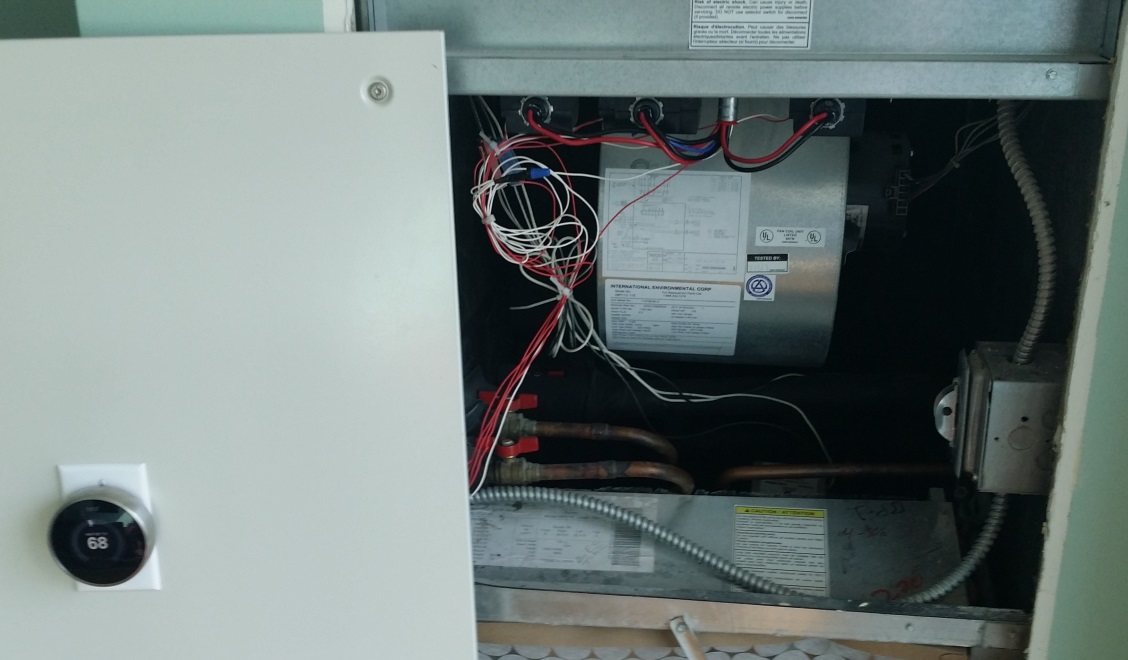
Time to tie all this disparate information to the real world. With my wife, Ashley, looking on in disdain, I removed the front panel of my HVAC system and started poking around. Ash looks unhappy and little Skye resigned…

Disdain

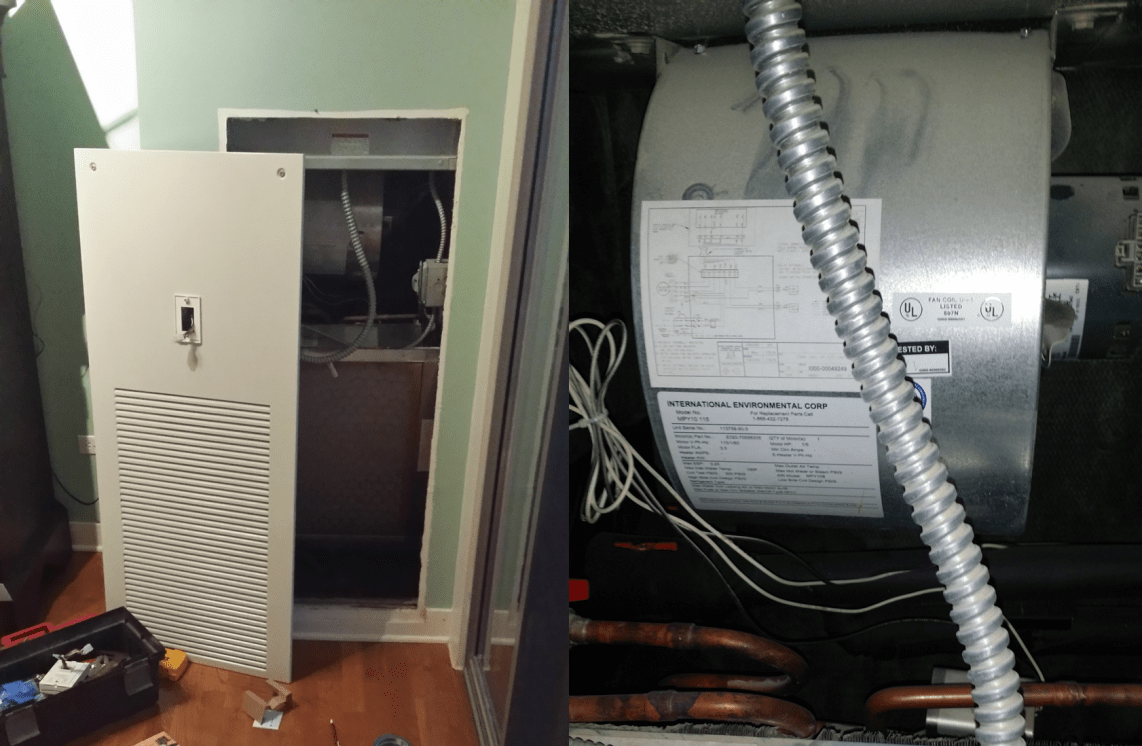
Here’s a shot of my fan coil system – big view and close-up of the fan, coil and pipes.
Double 0

This is a “4 pipe system”. That means when heat is called by the thermostat, hot water goes into the heat exchanger via one pipe and out another, while the fan blows air through the heat exchanger to deliver hot air to my cold family. When the thermostat calls for cold, the same process happens through another set of pipes with cold water. Hence, 4 pipes total. The hot flow and cold flow are each controlled by separate valves, each with their own circuit, while the fan is controlled by another circuit. Three important circuits in total. (Geek note: this system has three fan speeds, each with its own circuit, which would make 5 circuits in total. I hate listening to loud fans, so I chose only to wire up the low speed, which is more than adequate with three fan coil units in a 2,300 sq ft apartment.)

Here’s the wiring diagram, which falsely led me to believe it was a 240V system (more on that later). The diagram was handy as I planned my relays and transformer fun.

Diagram 0

With three 240V circuits to control from the 24V Nest, I needed three 240V to 24V relays. I chose the Aube (Honeywell) RC840, sold by SmartHome.com. I also needed a 240V/24V transformer to power the nest. Easy, replace one of the relays with a relay + built in transformer, the RC840T by Aube.

Action: Tear it apart. Understand it, put it back together and make it better

At some point, the planning ends, and you have to jump in. This is the essence of what our startup CEOs do and why I love working with them. Find something that needs fixing and fix it. Or maybe break something that works and make it better. This was my chance to do the same.

Note: If you are considering doing something like this on your own, convince yourself not to. Should you not listen to yourself, be careful!! High voltage can kill you. Turn your breakers off!! 

The two relays, relay + transformer and nest arrived from SmartHome and Amazon in three days. I spent a few hours the next Saturday mapping out the wiring.

This was the plan:

Diagram one

Then Sunday morning: **Snip**. That was the sound of my wire cutters bifurcating the wire harness to the old thermostat. I was committed. No going back. Some drilling to mount the relays, stripping and capping wires, and I had the high voltage side hooked up.

This oneThat one

In the closeup above, you see the terminal designations for the low voltage side connections to nest. All of this took four hours or so. I go slow when I don’t know what I’m doing (and when playing with high voltage).

Pivot and learning: In other words, screwing up and clawing your way out of it

So it’s 3pm now. The winter sun is falling low, and polar vortex 3 is in full force outside. Will the kids have heat tonight?

My system is all wired up. Flip the breaker switch and turn on the nest. I go through the setup process – wicked simple. Should be ready to roll. With my kid, cat and wife watching, I turn the nest to engage heat. Nothing. Doh!

Fiddle, rewire, fiddle, rewire. The relays have an indicator light that is supposed to light up when called by nest. The heat and fan relay indicators are lighting up when I call for heat, but the fan and valves aren’t engaging. Hmmm, the relay lights are actually quite dim. Uh oh. The system isn’t 240V; it’s 120V. The power going through nest from the transformer+relay and delivered to drive the other relays is ½ of what it should be, 12V not 24V. Not strong enough to trigger the load circuits. Oops. There are a variety of reasons I should have known this before, but let’s not let thinking get in the way of action.

Choices: no heat for a few days while I order a 120/24V transformer online. Or pray for an option at Home Depot or RadioShack. Both had a number of options online, but local stocking was not looking promising.

Love and support: You never get anywhere by yourself

Through growing piles of tools, wire cuttings and now more cursing, Ashley is her amazing, beautiful, patient self. “See ya, headed to Home Depot,” I say, not letting onto my failure. She smiles back and has the kids huddled together for warmth reading a book. We both know she knows what’s going on.

Home

I have so far not helped at all with the kids the whole day as I pursue my dreams of building and making. Sound familiar? Yup, makes me appreciate the wildly supportive spouses, families and friends who back our entrepreneurs as they make their own dreams come true.

Last chance – buy local: But, ugh, it just feels like brick and mortar retailers are giving up

Home Depot was a total strike out – no transformers or relays in store at all. I guess this isn’t shocking – like most retailers, they are now focused on selling stuff that is too big to ship to your door or stuff that you need today.

In the old days, you could assemble a computer with parts from RadioShack, so I gave them a shot. I walked in and was pretty sure I was the only customer they had seen all day. There was one of every SKU on the wall – yes exactly one – evidence of a failing retail model desperately clamping down on working capital. I asked if they had 120V to 24V AC transformers. “nope”. I refused to believe him. I couldn’t. This was my only chance not to sleep on the couch that night. So I spent 20 minutes looking around. On a bottom shelf in the back corner, I found a dust covered 120/24V transformer in a package that looked like it had been opened and re-closed with staples six times. Sold. But what if I had needed three or had actually listened to the sales associate who said they didn’t have any? Retailers are in trouble. It was not a surprise a few days later when I saw that RadioShack was planning to close 20% of its stores.

Take two: If you hadn’t failed the first time, would you have enjoyed the second time as much?

More drilling, wire cutting and an hour later, I’ve got my new setup wired together and ready for testing. The updated wiring diagram looks like the following – notice addition of a separate transformer.

Diagram 14

With another component, the inside of my fan coil now looks a bit like Medusa. But ready to test nonetheless.

FINALE

(Second) moment of truth. I throw the switch and rotate the nest to test cool. The valve flips and fan comes on. Eureka. OK, how about heat. Hmmm. Valve flips, but the fan doesn’t come on. Uh oh. I’m pretty sure by now that the wiring and hardware is all working. Time to call Nest, but it’s now 4:30 pm on a Sunday. Going to be a cold night after all…

Service: It’s not just what you do, but how you do it.

If you’ve ever called an electronics or cable company for service, you know how painful it is. Cable and utility companies have an excuse – they are near monopolies – they don’t need to provide good service to keep you as a customer. There is no excuse for electronics companies. Apple figured this out and has led the way in being the “zappos” of electronics. No warranty? No problem. We’ll fix the screen (we know you’ll be back for more).

Nest has followed Apple’s lead. I got a service tech on the phone immediately… at 4:30pm… on a Sunday. Wow. But you’ll recall I was installing nest onto a system that nest says it specifically does not support. I was 90% sure they would immediately say they couldn’t help me. 15 minutes later after elevating to a second tier service tech, we had everything working. Not once did they mention that my system wasn’t supported. They just helped me make it work, and they were wildly nice and polite… the kind of guys I’d want to have a bourbon with, the kind of people I would welcome into my home. Glad I did. Contrast this with my having tried every other internet service to avoid using Comcast because of how they treat customers.

Here is the system all packaged up with zip ties, tape and better connectors. Cherry on top. It has worked amazingly well. We never have to touch it. It just works.
Cherry

Game over: The battle for the home has just begun but may be over quickly

So??? With an estimated penetration of less than 5% in a slowly adopting durables market, it seems like home automation should be up for grabs by lots of players. Plenty have their eyes and efforts on the home automation SaaS opportunity besides Google – ADT, Xfinity/Comcast and others who have been in homes for decades – with paid subscription models. The problem for these players is they are woefully under-prepared to compete with Google.

My nest installation is one small step for my family, but one big step for Google. Google knows pretty much everything about me and also know how to generate value from that data. ADT and Xfinity have no idea how to do this. Soon, these older-players-trying-to-rethink-themselves will be competing with Google’s free or near-free software offerings that monetize me via ads or affiliate marketing revenue. On top of that, Google will provide better service and garner more trust.

Google’s android took the smartphone market very fast, and I expect Google to do the same in the home (adjusted for a much slower evolving housing market, of course). There will be a role for startups that have hardware and software ancillaries that Google and desperate competitors want to buy, but real market ownership by an emerging startup is very unlikely.

GDP = people. People need water and food

I couldn’t help thinking the following when looking at the much tweeted underlying chart at Daily Infographic. A few cities house the people that produce much of the US’s GDP, but the rest of the country feeds and waters them. That’s why we invested in @farmlogs.

Source: http://daily-infographic.tumblr.com/post/77214444514/map-that-shows-half-of-u-s-gdp-is-produced-in

Avoid a churn ‘CaSaaStrophe’: Don’t forget the service in SaaS

So you launched your shiny SaaS product. Customers are buying. You’re golden! Right? No, this is just the beginning. You sold them software, now it’s time to provide the service.

Hyde Park Venture Partners has made 18 investments over the last two years, most with newly launched SaaS products. This is what we’ve learned:

If you Google “sales funnel image” you will get lots of narrowed funnels with last stage of“purchase” or “decision”. This is a catastrophic way of thinking for a startup… a startup’s sales process needs to tie to its delivery process. We investors are often guilty of pushing sales without asking the question “then what?” Startups should think about what they do as a more complex pre-sales and post-sales funnel as follows.

Funnel

Customers create value for your business (and you for them) with Engagement, Expansion and ultimately Renewal. Purchase is only the beginning. How do you deliver this? Service and account management. Most startups forget about these functions in the beginning until their customers teach them the hard way… by churning.  The grey arrow is meant to show that post sales customer value creation is a cyclical process. The more customers engage, the more they expand, then renew and continue to engage. Awesome.

Most of our seed, and some of our Series A investments are still in the “founder sales” stage where founders are doing most of the selling to further advance product/market fit and define a process that they can hire sales people into. There should also be a “founder service” stage where one or two founders (Churn Czar) is laser focused on post sales engagement, expansion and renewal so that this process too can be codified and repeated… and most importantly, the customer base you’ve invested in, maintained.

In this stage, Churn is your arch enemy. Churn is defined in a number of ways. Common definitions are:

Customer # churn:

# of customers in a month/ total # customers

Customer $ churn:

$ of MRR lost in a month/ total MRR

OR

($ of MRR lost in a month – $ of MRR expanded within retained customer base)/total MRR

Each of these can also be defined per quarter or per month. I don’t like the last definition of $ churn (also called net $ churn) because it can hide problems…. a clever way of making things look good for fundraising… not a good operational metric. It’s GREAT if you are expanding MRR within your retained customer base, but losing MRR within your churned customer base is still an issue to address. Watch loss and expansion separately.

Use renewal rate as your leading indicator when you have contracts.

For an early stage startup, churn (especially net churn) is not a good early warning sign if you have customers under contract for longer than a month, say a year. Under these circumstances you may not have any retention feedback from customers until an entire year of selling (and service!) has passed. Then in the 13th month as contracts start coming due, even a renewal rate of only 60% can falsely seem okay in terms of churn. Example: let’s say your new SaaS business sells 10 contracts a month at $5K a month and signs 1 year contracts. It sells at this rate for 12 month,  1/3 of the contracts double by the end of the year, so now the business is doing $800K in MRR = 10*5K*12+ (10*5K*12)/3. Nice! Now in the 13th month, 10 contracts come up for renewal, and only 6 renew. Meanwhile, 5 more contracts double. Your monthly net $ churn is ((4*5k) lost – (5*5K) growth)/800K = -0.625%. You show this to your board and you like like a freakin’ genius! Negative churn! But this masks that your renewal was only 60%… AKA your loss rate is 40%. That means 4 of 10 customer ditched you when they had the chance…. scary.

OK, so that’s how you measure the problem, but how do you get ahead of it?

There are three core reasons behind poor renewal rates and churn:

1. Selling wrong product to right (or wrong) people: This is a product/market fit problem. Read this from @mikekarnj and pivot.

2. Selling right product to wrong people: This usually means you’re selling to two or more segments – in B2B SaaS, say businesses with <50 people and businesses with 50-250 people – one is not sticking. Disaggregating churn and renewal by customer segment will help you find where the problem is after the fact, but you can see it in advance by disaggregating engagement metrics (see below) by segment. Note that this problem and example are VERY common in B2B SaaS. The belief that SaaS would emancipate the elusive and huge SMB segment for profitable software penetration hasn’t worked out for a lot of startups. SMBs are costly to find and hard to keep sticky. Tough CAC/LTV economics. Medium sized businesses, however, tend to work out better

3. Selling right product to right people but not effectively managing post-sale service:

In this situation, there is product/market/segment fit, but you’re not getting your product to stick because you forgot about the service.

Watch the right engagement metrics:

You can’t know or fix what you don’t measure. Real time engagement monitoring is critical in any SaaS business. Depending on your business, monitor:

  • Logins (almost all business)
  • Files uploaded (think Dropbox)
  • Profiles created (think CRM)
  • Users added per account
  • Etc….

Don’t fool yourself with cumulative numbers. Watch metrics per period and per customer to get a real understanding of what’s happening. And watch them every day on a big screen in your office like our friends @farmlogs. Monthly isn’t enough – you’ll be 30 days late in figuring out a feature release issue or customer problem. Then don’t stop with aggregate numbers. Aggregate numbers are a great way to monitor your startup’s overall health, but not specific customer health.

Remember that churn and customer loss outcomes are not won or lost in aggregate! It’s hand-to-hand combat.

To this end, have another big screen that highlights at-risk customers. Define parameters to surface customers for that board. Some flags might be:

  • Hasn’t logged in for X days
  • Uploaded files are dropping or falling below Y threshold per week
  • User base within the company is declining
  • Etc… all depends on the business

Geckoboard, Panic Board, IFTTT and Zapier, among others, have made this type of monitoring so easy. You don’t even need a precious dev to do it.

Have a service plan/organization

Don’t expect your customers to contact you with problems. They might just churn first! The purpose of the metric monitoring above is for YOU to identify the problems first and reach out proactively. Call and e-mail your customers and see what’s going on. Offer training (scalable video modules or 1:1 depending on price point). Help them get value out of the product.

Your startup resources are constrained, but it’s time to start thinking about the people who will monitor and re-engage customers when there’s a problem…. not to mention upsell to them. This function falls to a founder at first (your Churn Czar). Eventually it’s an account management and a service organization.

If you sell low priced SaaS, outreach and engagement marketing can and should be automated. E-mail new customers content on how best to use their new tool. Customize ongoing e-mail outreach to specific customer use/needs, and offer webinars. Flag customers who haven’t engaged at all, and call them, no matter what the price point. They are about to churn!

If you’re selling high priced SaaS, call new customers every week in the beginning and thereafter monthly. Let them know who their account manager or service rep is, offer support on workflow integration, training, and data migration. Use these convos to upsell and renew.

As account management matures, begin compensating reps on up-sells and renewals. Good median benchmarks are 2% commissions for renewals and 6% commissions for up-sells. Note that it is very hard to have sales and account management in the same department… or at least to have the same reps doing both. Inevitably, you will get the incentive balance between commissions on new and renewal/upsell wrong and suddenly you’ll be doing all new sales (and ignoring your existing customers) or all upsells.

When are customer service and account management the same thing? When your product users and deciders are the same people. If you have a hierarchical sale, however, with users at the bottom of the org and deciders at the top, you likely need to keep customer service and account management separate.

Some other business model watchouts that lead to higher churn

We’ve seen a few business model flaws that naturally lead to churn. Price-per-seat and metered models tend to increase the likelihood of churn. Your customers will try to limit users and use to avoid cost preventing organization workflow integration and adoption – the exact opposite of what you want. This leads to churn when one of the few users leaves or someone who doesn’t use the product finds underwhelming support in a budget review.

We prefer the big tent approach. Price your product based on general organization size or revenue under management and then encourage use across the organization… the more users the better! This gets you embedded and increases the likelihood of renewal even if your original champion moves on. Once deeply integrated and “stuck” you will be in a good position to negotiate a higher price in the next renewal cycle when you point to all the internal user growth!

CaSaaStrophe avoided. I hope.

Who do you serve? Be responsive to them

People are everybody’s business.

Ask yourself: What people do you serve in your job or business? Customers, employees, channel partners, investors or all of the above? Are you really responsive to them.

Chances are your primary mode of communication with any of these constituencies is e-mail… maybe text or twitter. This has changed a lot even in the last few years. My phone almost never rings, yet I have conversations via e-mail and text that I would never have had a few years ago.

Many pundits warn the loss of personal interaction and inefficiency of problem solving with rapid fire digital conversations… They may be right, an important topic in itself. But this article is about optimizing how you respond when the medium is e-mail.

If people are your business, and people communicate mostly via e-mail, then e-mail (twitter, linkedin…) is your business too.

A company I know well recently visited silicon valley to raise money. The company had long been in communication with three valley VCs and emailed all three VCs in advance of their visit to setup meetings. Two VCs responded quickly and setup meetings. Two weeks later one issued a term sheet that was soon signed. Because the round was tight, the third VC – who didn’t respond to the company’s initial e-mail but later wanted in – was cut out.

Being responsive matters.

This is one of a few firm operating values at Hyde Park VP. It should not be a differentiator as a seed stage VC fund… shouldn’t every VC be responsive to the entrepreneurs they serve?… but has proven to be nonetheless. Turns out many VCs are just not very responsive. No matter what business you’re in, being responsive matters because it:

    • Makes people feel respected and appreciated: Don’t you feel good when you send an e-mail and get a response quickly?
    • Moves the ball down the court faster: As boundaries between organizations, departments, companies and roles blur, the binding workflow tool is increasingly e-mail – like it or not. Don’t become a bottleneck.
    • Keeps things from falling through the cracks: The longer you wait, the more likely you or the sender will forget about whatever needs to be done. Assuming the e-mail was sent for a good reason (a bold assumption, true), that’s a shame.

Lots of people say they are overwhelmed by their e-mail, but there are really no excuses. Sam Yagan – entrepreneur, CEO of Match.com and advisor to HPVP – responds to every e-mail I send him within 24 hrs. He’s an officer at a public company, there’s no way I’m high on his constituency list AND I’m pretty sure he gets more e-mail than all of us combined.

So, a few obvious tips to manage your e-mail:

  1. Send fewer e-mails, get fewer e-mails
  2. Don’t respond unless you need to (aka, choose your battles)
  3. Set guidelines with colleagues to minimize CC and BCCing (aka, trust people more)
  4. Write short/direct e-mails – they are easier to understand and faster to write
  5. Setup a phantom e-mail to use for e-commerce lists (duh)

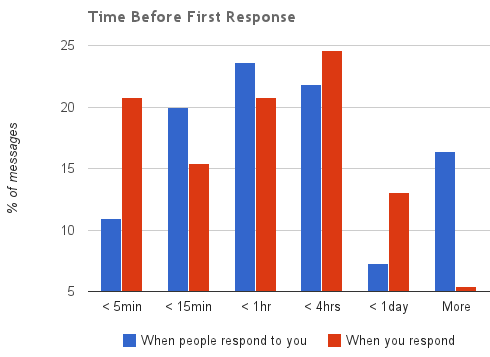
As with any behavior, we need to monitor and work on being responsive. I have service levels for different constituencies and monitor my performance using GmailMeter. My goal is to respond to any e-mail from my business partner or other colleague within one hour, any portfolio company or investor e-mail within three hours and all e-mails within 24 hours. In practice, I average quite a bit faster than this with 55% of my e-mail responses sent in less than an hour. The only e-mails or linkedin messages I ever ignore are for “cold” e-mailed business plans clearly out of my focus, geography, interest. Here are my stats from GmailMeter.com:

Time

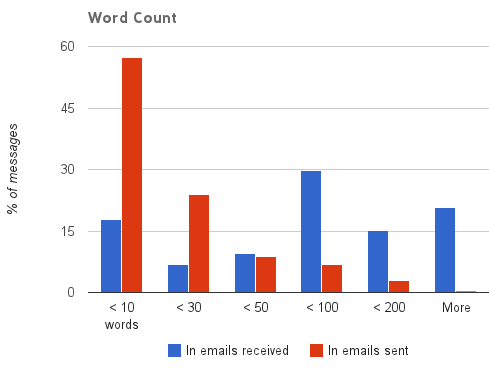
The tradeoff to being highly responsive is that in order to be so, you probably need to be more terse (pithy?) – fewer and shorter words to say the same thing. I have to be careful about this with people I don’t know well. But with professional relationships I know well, I’ve even started using text-speak (b rght thr) – something I would never have done in 2010. No one seems to care. Here are my wordcount stats. Pithy.

Length

To respond fast, you also need to make decisions fast.

This is another tradeoff (or really a benefit?). When you put limits on time to response, you force yourself to make decisions faster. I’ve found this slightly increases my error rate on both the decisions themselves and how I communicate them, but not nearly enough to outweigh the benefits of speed.

Happy responding! It will be appreciated.

AngelList: VCs in sheep’s clothing?

It’s been a bit under 60 days since AngelList announced Syndicates. What do we know so far? Is it really the great venture capital rotation that @jason described? Is AngelList becoming the democracy of funding with successful entrepreneurs funding new founders, angels gaining strength and big bad VC’s pushed to the side? Turns out, not really.

Amidst the defensive VC jabber that ensued the launch of syndicates, @bfeld made a bold move and launched an FG syndicate. Whether Brad tipped the tide or was just a leading indicator, VCs are now playing heavily on AngelList. It is a low cost way to participate in seed deal flow. But not only are VCs seeking participation, capital is actually seeking them on AngelList. Turns out would-be syndicate members are drawn to professional managers. Go figure.

AngelList: (some) VCs in sheep’s clothing

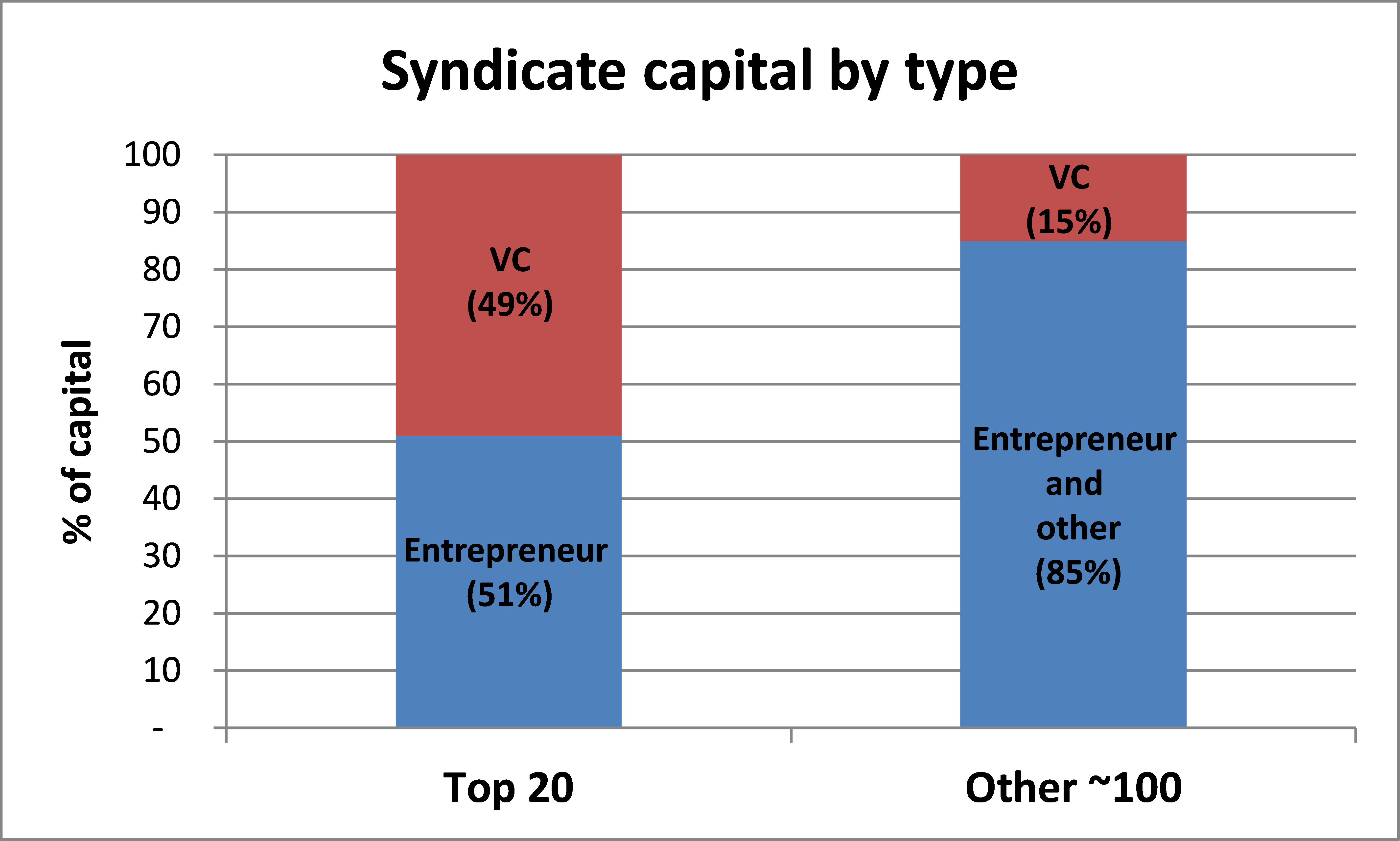
The chart below shows the top 20 AngelList Syndicates as of Nov 5th (note that #1 Kevin Rose has added $400K since then!!!). The distribution of syndicates has a VERY long tail, so these top 20 account for a whopping $8.1M out of $9.9M total. 9 of these 20 are what I call “VC” syndicates – led by a VC or general partner at a venture fund. The rest tend to be successful entrepreneurs. On a capital basis, 49% is “VC” and 51% is “entrepreneur”.

Image

Source: AngelList Nov 5, 2013

Note that there are three Google Ventures GPs in this top 20 – Kevin Rose, MG Siegler, and Wesley Chan. They account for 31% of the syndicate capital. Wow… seems like a pretty strong competitive funding position for Google Ventures, a smart – and likely concerted – move. As usual, Google is everywhere.

The point is that many of the same investors that companies meet with in fancy Sand Hill digs are now cruising for love on AngelList. There are also, of course, renowned entrepreneur angel investors like Tim Ferriss, Dave Morin, Jason Calacanis, and Naval Ravikant who are heavily empowered by the platform too.

This is all a terrific outcome for entrepreneurs, increasing the flow of capital to startups and reducing the transaction costs of landing capital. Contrary to the buzz, however, AngelList is also a boon for VCs who choose to ride the wave… as we can see by Google Ventures’ market position. Even my own fund, Hyde Park Venture Partners, dipped a toe with my partner @iraweiss backing FG’s syndicate. We don’t have enough brass, time or capital to do one ourselves, but we’re excited to learn with Brad.

Capital flows to expertise, time and access

There’s something else these data are telling us. Investing successfully in young companies takes expertise, time and access.  The capital is flowing to people who are “proven” along these dimensions – in many cases VCs – not just any angel investor. Shown below, while nearly half of the top 20 syndicate capital is “VC” led, only 15% of the tail capital fits this bill. Viewed through another lens, successfully formed syndicates (the top 20 all have at least $60K in capital, the tail median is a measly $12K) are much more likely to be VC led. Maybe we should call it VCList.co. I’ll have to check GoDaddy for that.

Image

Source: AngelList Nov 5, 2013

For all you haters: Yes, I am a VC. I get it, I’m biased. The analysis also isn’t perfect because it only looks at syndicate formation, not capital velocity. Impact to startups could skew differently than the formation distribution if, say, the “entrepreneur” syndicates invested more often than the “VC” syndicates. But I think you get the point.